Invoice entry, CV screening, marketing content, customer support & AI agents, onboarding, lead scoring: here are the 6 processes that offer the fastest return on investment, and why to start with them rather than any others.
Definition: what is an automatable process?
An automatable process is a sequence of repetitive tasks that follows stable rules, uses digital data and does not require complex human judgement each time it runs. Intelligent automation means entrusting these tasks to a software system and reserving human intervention for the steps that really justify it. This is the HITL (Human-In-The-Loop) principle: AI executes, the human approves and decides.
Three criteria let you immediately identify a process in your SME that is ready to be automated. It must be:
- Repetitive: carried out at least once a week.
- Rule-based: the same rules apply every time, whatever the occurrence.
- Low in human added value: no complex judgement, no sensitive relationship, no strategic decision involved.
If all three criteria are met: automate. Otherwise, simplify the process first, then automate. Automating a bad process only speeds up its inefficiency; it is the most common and most costly mistake, as we explain in our article onthe 7 critical mistakes to avoid in process automation.
Why these 6 processes first?
These 6 processes were not chosen at random. They all share one decisive characteristic: their ROI is measurable from the first week of deployment. They concern the most time-consuming operational functions in any SME, and automating them requires no heavy infrastructure.
Process 01 ; CV screening, automatic analysis and pre-selection of candidates
For an SME that is hiring, each job ad can generate dozens, sometimes hundreds, of applications. Handling them manually takes several hours of work per ad, often on tasks with no value: opening emails, downloading attachments, skimming for a first sort, entering information in a spreadsheet. Meanwhile, the best candidates are waiting for an answer.
Concrete example; Lettings agency, 8 employees
Every application received is analysed automatically against the defined criteria (experience, education, availability). A personalised acknowledgement is sent in under 2 minutes. Qualified candidates are passed to the recruiter with a structured file. Unsuccessful candidates receive a polite automatic message. The recruiter only reads files that have already been filtered and concentrates on interviews.
Automating CV screening is part of an underlying trend: according to Deel, 56% of HR tasks can be automated without radically changing existing processes. This massive adoption is easily explained: the gains are immediate and deployment complexity is low.
Process 02 ; Marketing content and automated nurturing
SME marketing teams spend an excessive share of their time recycling content: turning an article into a LinkedIn post, rewording a post as an Instagram caption, writing the newsletter email on the same subject. Intelligent automation can generate these different formats from a single brief, and automatically trigger a nurturing sequence as soon as a new lead enters the CRM.
Concrete example; B2B consulting firm, 15 employees
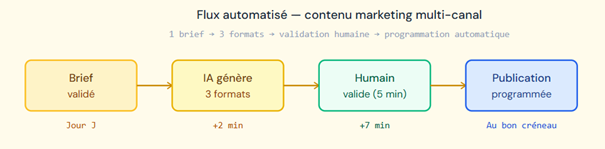
A new lead fills in a form → personalised welcome email sent within 2 minutes based on their sector → D+3: educational content targeting their main problem → D+7: client case from their sector + invitation to a diagnosis → D+14: personalised sales follow-up. In parallel, an approved brief automatically generates the LinkedIn post, the caption and the newsletter email, scheduled at the times of best engagement.
What HITL changes here: AI generates the formats and schedules the posts. Your marketing teamapproves in 5 minuteswhat used to take 3 hours to produce. Creativity stays human; repetition is automated.
The results of marketing automation are documented: according to Incremys (2026), 85% of marketing tasks can now be automated with AI. It is no longer just for large groups; it is accessible to any SME with the right tools.
Read our article onthe myths about automationto debunk the idea that AI “replaces” creativity.
Process 03 ; Invoice entry and automatic invoice generation
Manual invoicing is one of the most time-consuming and risky processes in an SME. Each invoice involves data entry, checking, sending, archiving and possibly a correction if an error has crept in. With IDP (Intelligent Document Processing), these steps become fully automatic.
Concrete example; Services SME, 20 employees
When a quote is approved, the invoice is generated automatically from a smart template, emailed to the customer with a payment link, archived in the accounting software and added to the cash-flow tracking table. IDP reads incoming supplier invoices, extracts the data (amount, VAT, supplier, issue date) and feeds it directly into the accounts. Zero manual entry. Zero copying errors.
80% of transactional accounting tasks can be automated with AI (Thunderbit 2025), and it is also one of the fastest to deploy with the right tool.
Process 04 ; Customer support and a connected business AI agent
A traditional chatbot answers predefined FAQs. A connected business AI agent does something fundamentally different: it queries your CRM, stock software, invoicing and schedule in real time to answer personalised questions using your company’s real data. The difference in value is profound.
Concrete example; E-commerce, 6 employees
A customer asks:“Where is my order from 3 April?”→ The AI agent queries the carrier’s API and answers in 3 seconds with the exact status and estimated delivery time.
A prospect asks:“Is item RF-2024 available?”→ The AI agent checks stock in real time and suggests alternatives if it is out of stock.
60% of requests are resolved without human intervention. The team only handles complex cases, with the full context provided automatically.
Pressure on response times keeps rising: according to Thunderbit (2026), 62% of consumers prefer to chat with a bot rather than wait for a human. The average response time of an AI chatbot is now under 3 seconds, impossible to match manually. For more information, discover The 5 questions your AI agent should be able to answer instantly.
Process 05 ; Automated employee onboarding
Onboarding is often overlooked in SME intelligent automation projects, and yet its impact on talent retention is massive. 22% of resignations happen within the first 3 months (Deel, 2026). Poorly managed onboarding costs between 0.5 and 2 times the annual salary of the person who leaves (recruitment, training and lost productivity included). On the other hand, automating it cuts the time spent on administrative tasks by40 to 60%, freeing HR for the human support that really makes the difference.
Concrete example — Industrial SME, 45 employees
As soon as the contract is signed, a workflow automatically triggers: creation of IT access according to the job profile, sending the welcome kit (HR documents, team presentation, tools guide), enrolment in mandatory training, and a notification to the manager with the schedule of the first check-ins. What used to take 3 days of manual coordination between IT, HR and the manager is done in a few minutes, even before the new employee physically arrives.
Direct impact on retention: A structured onboarding process improves retention by82 %and increases productivity by70 %in the first months (Mercato, 2026). Automation ensures that every newcomer receives the same quality of welcome, without depending on a single available person.
Process 06 ; Lead scoring and automatic qualification
Your sales team receives leads from multiple sources (web form, trade show, LinkedIn, word of mouth). Without an automated system, all leads are handled the same way, with no distinction between a hot prospect ready to sign and someone who is merely curious.
The result: time wasted on unqualified leads, and missed opportunities on hot leads followed up too slowly. explanatory:
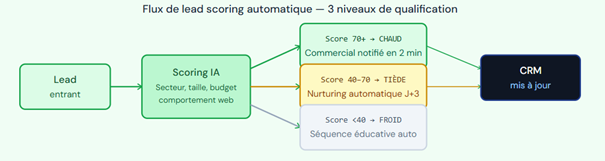
Automatic lead scoring lets your sales reps contact the prospects most likely to convert first. 70% of prospects sign with the first company to call them back (LeadValue, 2025). An automated scoring system ensures your hot leads are handled in under 2 minutes, not 4 hours.
This process relies on the behavioural data collected in your CRM (pages visited, emails opened, clicks, forms submitted) to assign a score in real time.
Where to start? A 4-step method
You now have a clear view of the 6 processes to automate first. But the real question is:which one should you choose first?Here is the Invaist method to get it right.
- Identify the most painful process
Ask your team: “Which task is the most repetitive, the most disliked and the most time-consuming every week?” The unanimous answer is your ideal candidate. Time how long is really spent on it; that is your ROI baseline.
- Map each step on paper
Before any tool: note each step of the process, the triggers, the people involved and the possible exceptions. A few hours of mapping avoid weeks of corrections after deployment. Simplify first, automate second.
- Test on a limited scope
Configure the workflow with Invaist and test it with a single user for 1 week. Check each run manually. Fix the exceptions. Only go live once everything is stable.
- Measure and communicate the gains
At D+7, D+30 and D+90, compare your KPIs with the baseline. Share the results with the whole team. These figures are what will build buy-in for deploying the next process, and the one after.
To better understand these processes and their impact, watch this video (in French)
https://youtu.be/5VKA5intnckWhich process will you automate first?
Invaist identifies the highest-ROI workflow in your SME and deploys it in under 3 weeks.
Free audit · No commitment · No change of tools · Reply within 24h
Our related solutions