Business process automation has become a cornerstone of digital transformation, promising greater efficiency, lower costs and improved productivity for French SMEs. Indeed, in France,60% of the companies surveyed have already seen significant operational productivity gains thanks to AI, according to a 2025 IBM study. These figures can only be achieved with a clear, optimised process foundation.
To ensure your approach succeeds, it is crucial to identify and avoid the common mistakes that can turn a promising investment into a financial black hole. This article explores 7 fundamental mistakes that companies must absolutely avoid in order to get the full benefit of process automation.
1.Automating poorly defined or faulty processes
One of the most costly mistakes is digitising processes that are inherently inefficient or poorly structured. In that case, automation would only speed up and amplify existing dysfunctions. Before any automation initiative, it is imperative to carry out an in-depth analysis and rationalisation of the processes.
30-MIN EXPRESS AUDITThis means mapping each step, identifying bottlenecks, removing superfluous tasks and clarifying roles and responsibilities. An optimised, well-defined process is the foundation of successful automation.
- Underestimating the complexity and hidden costs of implementation
Some companies assess an automation project solely through the cost of the software. Yet beyond the tool, there may be a few things to anticipate, such as integration with existing systems, customisation, supporting the teams, ongoing maintenance and technical support.
The aim is not to complicate the project, but to have a clear view from the outset. A structured approach avoids surprises and lets you deploy automation gradually, in a controlled way suited to the company’s resources.
3. Neglecting the quality of the data feeding the automated ecosystem
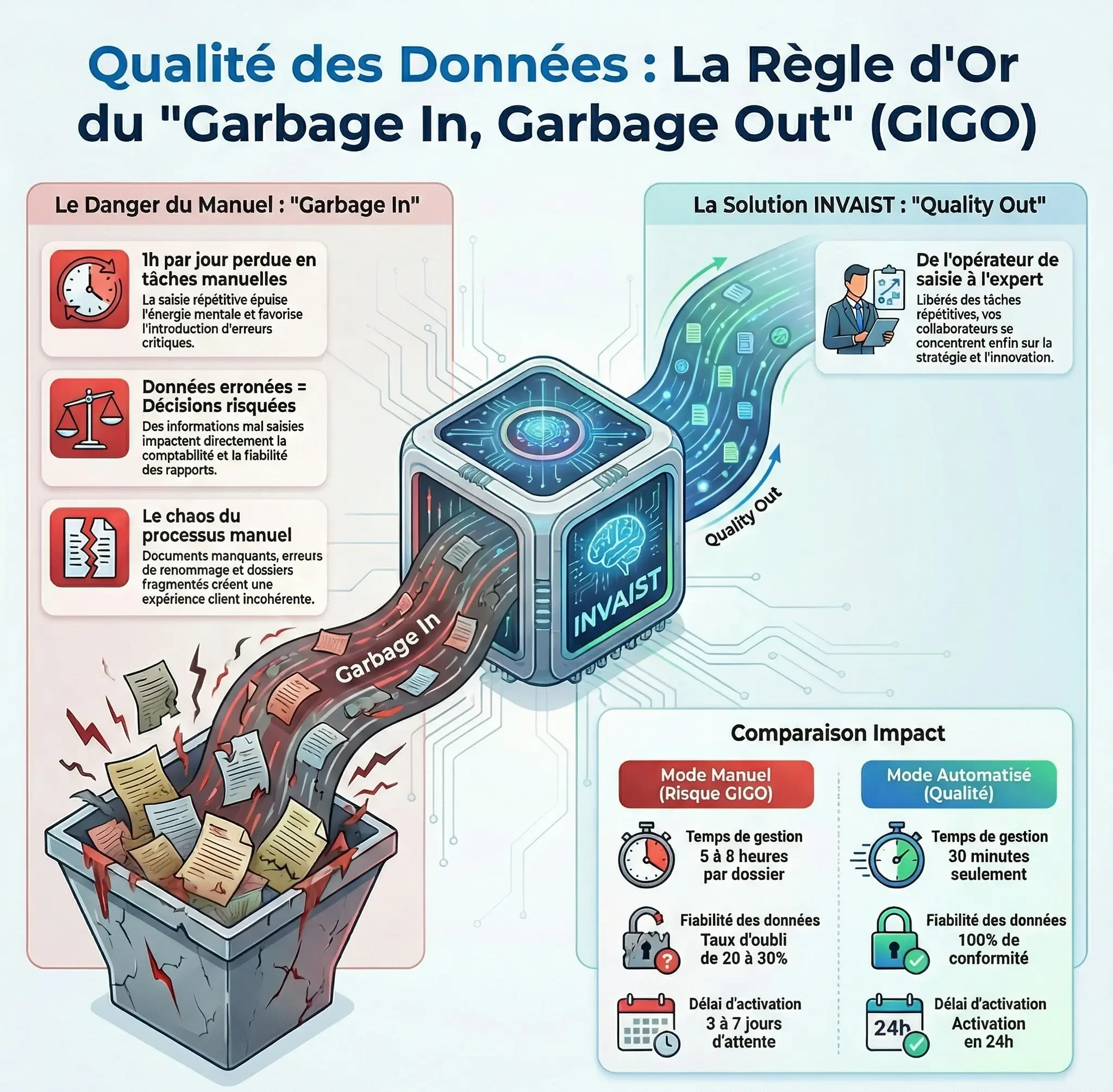
Automation feeds on data. If the data is incomplete, inaccurate or inconsistent, the automated results will be wrong, undermining trust and the expected benefits. This is the “garbage in, garbage out” principle. Data reliability is a fundamental pillar of any automated system. Before launching automation, companies must invest in cleaning, standardising and validating their data sources. A robust data governance strategy is essential to ensure the integrity of the information processed by automated systems.
- Choosing an unsuitable or overly rigid technology solution
The market for automation solutions is vast and constantly evolving. Choosing a platform solely for its popularity, or without a thorough assessment of the company’s specific needs, is a common mistake. An unsuitable solution may prove too rigid for your unique processes, lack essential features or be incompatible with your existing IT infrastructure, but all is not lost ! You can still automate without heavy infrastructure. It is essential to favour solutions that offer flexibility, scalability and customisation options, or even “low-code/no-code” approaches that let business teams adjust processes without excessive reliance on IT. A careful assessment must include the ability to integrate with current systems and the support provided by the vendor.
- Ignoring the human element and change management
Automation is above all a human transformation. Neglecting employees’ resistance to change is one of the main causes of project failure. Automation can be seen as a threat to jobs or a source of additional complexity. It is essential to involve end users from the earliest stages of the project, communicate the benefits clearly (freeing people from repetitive tasks for higher-value work) and provide suitable, ongoing training. The success of an automation project depends on acceptance and adoption by those who will use the new systems every day.
- Forgetting exceptions, edge cases and fallback plans
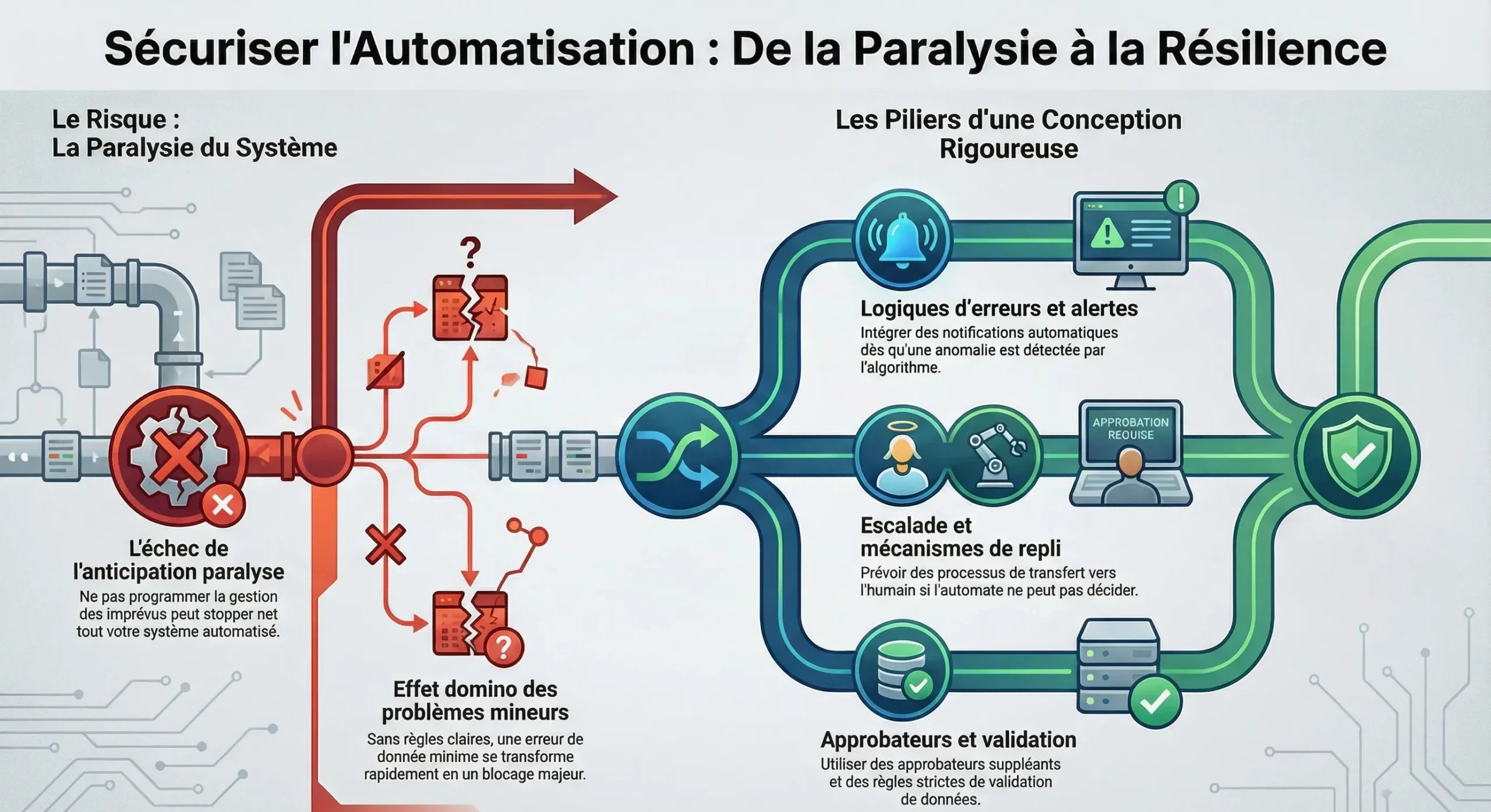
An automated process works perfectly... as long as everything goes to plan. However, the reality of a company’s operations is often full of exceptions, edge cases or unforeseen errors (a missing document, a delayed approval, incorrect data). Failing to anticipate and program the handling of these scenarios can paralyse the entire automated system. Rigorous design must include error-handling logic, automatic alerts, escalation processes and fallback mechanisms (such as backup approvers or data validation rules) to prevent minor problems from turning into major blockages.
-
Treating automation as a one-off project rather than an ongoing one
Automation is not a destination but a journey. Many companies make the mistake of seeing automation as a project “to be delivered” and then forget to maintain it. Yet business needs evolve, regulations change and technologies improve. An automated system must be regularly reviewed, measured, adjusted and optimised to remain relevant and effective. Putting in place a continuous improvement approach, with regular performance audits, user feedback loops and technology monitoring, is crucial to maximise the lifespan and ROI of your automation investments.
Conclusion
Process automation offers immense potential for the competitiveness of companies, but its success is never guaranteed. Avoiding these critical mistakes is fundamental.
Rigorous planning, a thorough understanding of the real costs, a commitment to data quality, a judicious choice of technology, a people-centred approach and a long-term vision are the pillars on which to build a resilient and successful automation strategy. By adopting this proactive approach, your company will not only avoid the pitfalls but, above all, turn its technology investment into measurable, lasting gains, rooted in the realities of its market.
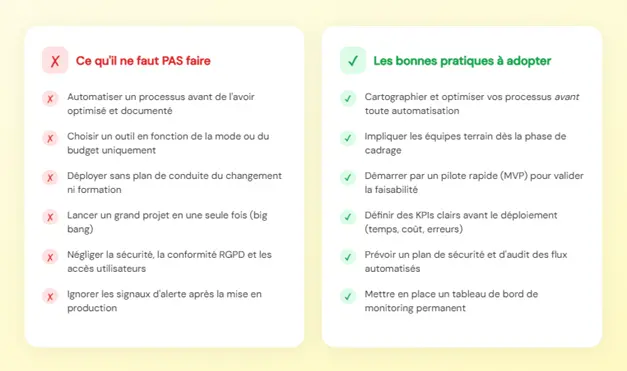
The Do / Don’t guide
Operational checklist before launching your automation project
FAQ
What is the most common mistake SMEs make when starting out with intelligent automation?
Automating a poorly defined process is mistake number one. When a process is inefficient or fragmented, automating it only speeds up its flaws. The result: a system that produces errors faster than before. The golden rule is to map, simplify, then automate (never the other way round).How can I stop my automation project from costing more than planned?
The real cost of a project always exceeds the cost of the software alone. You need to anticipate from the outset: integration with existing systems, workflow customisation, supporting the teams, ongoing maintenance and technical support. To avoid surprises, take a phased approach with budgets defined for each step. A pilot on a single process lets you validate the real costs before expanding. Low-code/no-code solutions significantly reduce integration costs.Why is data quality crucial before launching intelligent automation?
It is the “garbage in, garbage out” principle: if your input data is incomplete, inconsistent or wrong, the automated results will be wrong, and wrong faster than with a manual process. Before launching any automation, invest in cleaning, standardising and validating your data sources. A data governance strategy is essential, especially if you connect several tools (CRM, ERP, invoicing). This step is particularly important in IDP and automated document processing projects.How can I involve my teams to avoid resistance to change in an intelligent automation project?
3 levers are decisive: 1. Involve end users from the diagnosis stage; they are the ones who know the process’s real friction points. 2. Communicate the benefits clearly: time recovered, errors avoided, more rewarding work. 3. Train continuously and appropriately, not as a one-off. Teams that take part in designing an automated workflow are rarely the ones that resist its deployment.Should you plan fallback options in an automated process? How?
Absolutely; it is one of the most underestimated mistakes. An automated process works perfectly on standard cases, but operational reality is full of exceptions: a missing document, a delayed approval, incorrect data. Rigorous design must include error-handling logic, automatic alerts, escalation processes and fallback mechanisms (backup approvers, alternative validation rules). Without these safeguards, a minor problem can paralyse the whole system.Want to know where to start?
Invaist audits your processes, identifies the quick wins and deploys your first automated workflow. No IT team. No disruption to your organisation. In under 3 weeks. No commitment · Reply within 24h
30-MIN EXPRESS AUDITOur related solutions