SMEs face an explosion in the volume of documents to process every day: invoices, purchase orders, payslips, customer or supplier contracts… Yet many of these documents are still handled manually, with a risk of errors, lost time and growing difficulty ensuring regulatory compliance.
Intelligent Document Processing (IDP) offers a powerful technological answer to these challenges.
Long seen as a solution reserved for large companies, IDP is now becoming accessible, simple and suited to the realities of SMEs that want to become more agile, reliable and competitive.
But what exactly is IDP?
It is not just a smart scanner.
It is not a solution reserved for large companies.
It is an approach that automatically reads, understands and structures your documents so that they feed directly into your business tools (accounting, CRM, ERP, document management, etc.).
Thanks to AI, pre-trained models and a simple interface, SMEs can now automate tasks that used to be long and tedious:
- Automatically extracting the key data from an invoice or a contract,
- Filing documents in the right folder or system,
- Triggering actions (approval, accounting export, payment, etc.).
- Automatically checking the document’s compliance with your internal rules
- or legal obligations (mandatory information present, VAT format, archiving, deadlines…).
Intelligent Document Processing relies on a combination of technology building blocks designed to automate without dehumanising:
- Advanced OCR, to read scanned or photographed documents accurately, even when they are imperfect or unstructured,
- Artificial intelligence (AI) and NLP, to understand the context, detect key entities (amounts, names, dates, etc.) and interpret the intent of a document,
- Customisable business rules, to adapt to your specific use cases, document formats and internal logic,
- Supervised automation workflows, built on the principle of Human in the Loop : when doubt remains or a confidence threshold is too low, a user can approve, correct or enrich the data before it is fed into your system,
- Connectors and exports to your business tools (accounting, CRM, ERP, document management…),
for smooth automation, with no re-keying.
What IDP really changes for an SME
Implementing an intelligent document processing (IDP) solution in an SMEis not simply replacing manual entry with an automated system. It is a profound transformation of the way information flows, is processed, checked and used.
In practice, the first visible effect is the time saved. Whole hours each week are no longer spent opening attachments, extracting an amount by hand, renaming a file or entering an invoice in an Excel table. These are routine tasks that, added up, significantly reduce teams’ operational efficiency. With IDP, all of this becomes almost instantaneous.
But the impact does not stop there. Less manual handling also means fewer errors, so fewer corrections, less stress and better traceability. Information is correctly extracted, filed and passed to the right tools, with no double entry and nothing lost.
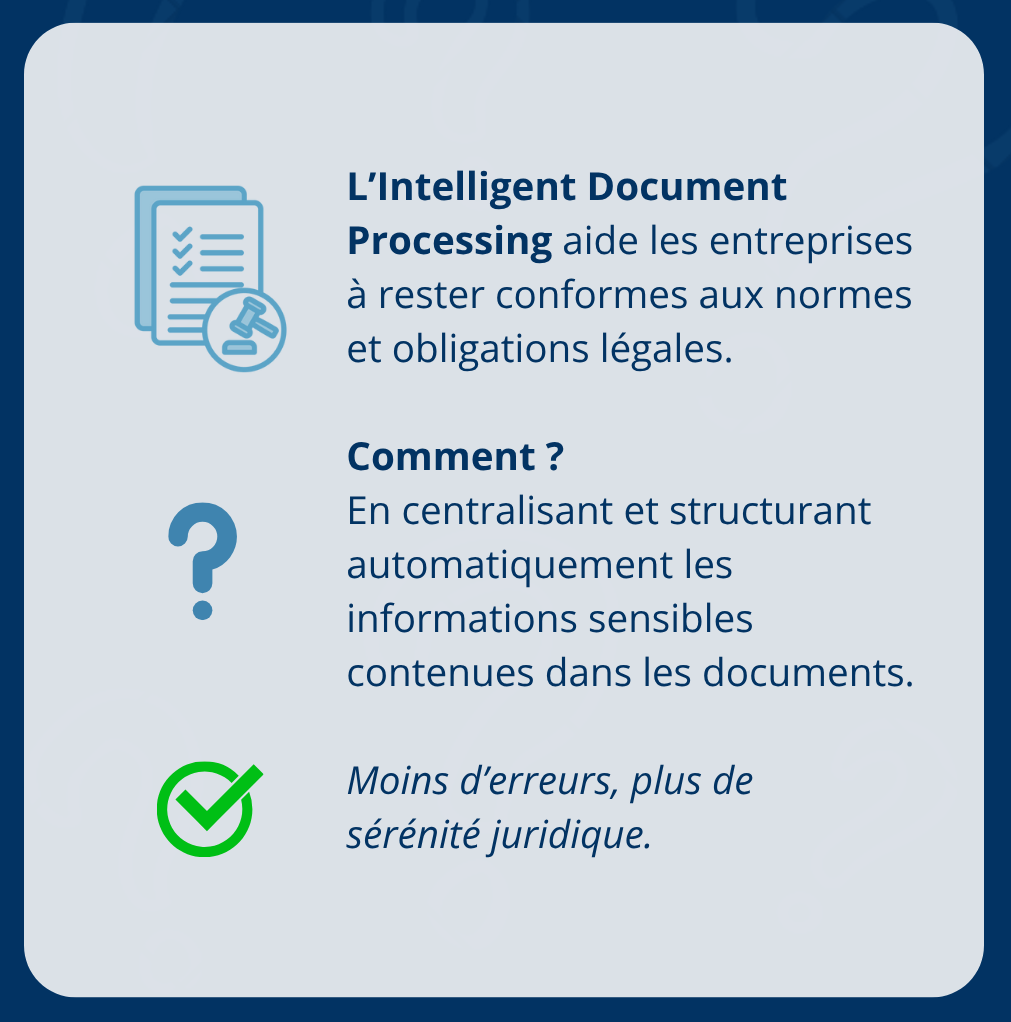
Another major advantage: compliance. IDP lets you structure and archive documents automatically, according to your rules, deadlines and obligations. You gain not only efficiency but also peace of mind on the regulatory front.
Finally, once the data has been extracted and standardised, it becomes immediately usable to: track your spending, feed your ERP, speed up supplier payments or enrich your CRM. Documents come to life; they become levers for decision and action for the company.
How an SME can move to IDP without complexity
Adopting Intelligent Document Processing in an SME requires neither a long project, nor an excessive budget, nor a radical overhaul of the information system. The key is to start small, with a concrete goal, and move forward step by step.
Step 1: Identify a document pain point
There is no point trying to automate everything at once. Start with a simple, repetitive but time-consuming task. For example:
- Processing supplier invoices received by email,
- Automatically sorting customer contracts or purchase orders, - Centralising and structuring HR documents (payroll, absences, supporting documents…).
Choose the most painful or most frequent flow: that is where IDP will deliver an immediate return on investment.
Step 2: Choose a solution that fits your SME constraints
Avoid platforms designed for large groups, which are too complex to deploy. A good solution for SMEs should:
- Be available as SaaS, accessible from a simple browser,
- Offer ready-to-use templates (invoices, contracts, payslips…),
- Allow simple integration with your existing tools (via API or Excel export),
- Offer a clear user experience, without technical jargon.
A good indicator? You should be able to test the solution yourself in a few clicks, without needing a dedicated IT project manager.
Step 3: Measure the impact with simple indicatorsFrom the very first days, track a few very concrete KPIs:
- How many documents have been processed automatically?
- How much time have the teams saved?
- How many errors or re-entries have been avoided?
- How many manual steps have been removed?
The goal: quickly prove the value of document automation, without waiting for a “big project”.
Step 4: Expand gradually, according to your real needs Once the first use case is well established, the rest follows naturally. You will very soon be able to automate other flows: sales documents, incoming emails, customer files, HR reporting… Each new step builds on the previous one. IDP then becomes a cross-functional automation foundation that grows with your company. And what about people? Unlike “blind” automation, modern IDP includes intelligent checkpoints where your teams stay in control. The result: more efficiency without losing control or quality.Conclusion: IDP, a new era for SMEs
Intelligent document processing profoundly transforms the way SMEs can manage their documents day to day.
It is no longer a luxury reserved for large groups: it is now a concrete productivity lever, simple to implement and directly useful to your operations.
With IDP, document management is no longer just a cost centre or an administrative constraint. It becomes an accelerator of responsiveness, compliance and quality.
In our next posts, we will explore:
- Concrete use cases in SME contexts (accounting, HR, customer management…),
- The key KPIs for steering your document transformation,
- A clear guide to succeeding with implementation step by step.
And you, where would you like to start?
Which document tasks waste your precious time every week?
Our related solutions