Why these myths persist and how much they cost
In 2025, 26% of French small businesses were already using AI in their business processes, a figure that doubled in one year according to theFrance Num 2025 barometer (France). Yet a majority of business leaders remain on the sidelines. Not for lack of interest, but because they are convinced that intelligent automation is not meant for them.
These convictions have an understandable origin: they were true ten years ago. Industrial automation really did require technical teams, substantial budgets and projects lasting several months. Those days are over. And continuing to believe these myths in 2025 hands a real competitive advantage to those who have taken the step.
Myth #1: “Automation is too expensive for an SME”
“We don’t have the budget for that. It’s an investment only big companies can afford.” ❌ False
This belief dates from the era of SAP projects or custom RPA integrations billed at several tens of thousands of euros. It no longer reflects the reality of the market in 2025.
Today, low-code automation platforms are available from a few dozen euros a month.France Num officially confirms it: automation is no longer reserved for large companies with technical teams. Solutions accessible to small businesses, such as SaaS automation tools, require no particular IT skills; custom automation, however, requires a minimum command of logical flows and integrations. This is precisely why support from a specialist partner makes the difference between a fragile workflow cobbled together in-house and a robust, maintainable and scalable system.
And behind this new accessibility there is an engine: artificial intelligence. It is AI that today makes it possible to analyse a lead automatically, detect an anomaly in a KPI, prioritise an after-sales request or generate a report without human intervention. Intelligent automation is no longer just a matter of workflows. It is the AI built into these flows that gives them their real operational power.
✅ The reality: The real cost of automation is not the initial investment; it is the absence of intelligent automation. SMEs that automate their invoicing significantly reduce their payment times and unpaid invoices. Those that automate their reporting save several hours a week.
What business leaders often confuse: the cost of a custom project (several months, technical team, complex integration) and the cost of targeted business process automation (a few days with a specialist partner, ROI visible within weeks). These are two completely different realities.
The ROI of intelligent automation is measurable within the first few months on administrative processes (invoicing, reminders, reporting).
Myth #2 — “It will eliminate jobs in my team”
“If I automate, I’ll have to lay people off. My teams won’t understand.” ❌ False
This is probably the most deeply rooted myth, and the furthest from the operational reality of an SME. It is fuelled by spectacular announcements of layoffs at large tech companies, which have nothing to do with the context of an SME with 10 to 200 people.
In an SME, intelligent automation eliminates tasks, not jobs. It frees employees from manual data entry, repetitive reminders and Monday-morning Excel consolidation so they can focus on what really creates value: customer relationships, business development, process improvement
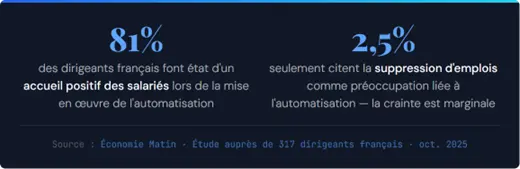
✅ The reality: According to the same study, 49% of French business leaders believe automation will create more jobs than it destroys by 2030. PwC’sAI Jobs Barometer 2025confirms that AI does not reduce employment; it redefines it: in France, AI-augmented jobs grew by 252% between 2019 and 2024.
Myth #3 — “It’s only for large companies with an IT department”
“We don’t have an in-house technical team. It’s not for us.” ❌ False
This misconception persists, and it is easy to see why: it was well founded a few years ago. The first automation solutions (RPA, complex IS integrations) did require advanced technical skills and dedicated teams. That model has been swept away by the democratisation of low-code platforms.
In 2025, 26% of French small businesses were already using AI in their processes, compared with just 13% in 2024. This doubling in one year, documented by the France Num 2025 barometer, did not happen because SMEs suddenly hired IT teams, but because the tools became accessible andAI automation agenciesnow allow SMEs to automate their processes without making their organisation more complex.

SME teams without technical profiles are now deploying their first automated workflows with the right external support.
✅ The reality: Intelligent business process automation does not require an in-house team. It requires a partner who knows your business, maps your processes and deploys the workflows for you. Your role: know your own processes. The rest is taken care of.
Myth #4 — “It’s too complex to deploy and maintain”
“We’ll break everything, lose data, and nobody will know how to maintain it.” ❌ False
The fear of complexity is often linked to a mistaken picture of what an automated workflow is. People imagine lines of code, servers to configure, fragile integrations that fall over as soon as you touch them. The reality of properly designed intelligent business process automation is very different.Automating doesn’t mean breaking everything.
A well-mapped, well-deployed workflow is more stable and more reliable than a manual process. It does not depend on one person’s availability, makes no data entry errors and ensures business continuity. The perceived complexity usually comes from a mistake in method: automating before formalising the process.
⚠️ The mistake to avoid at all costs: automating a bad process does not make it efficient; it simply makes it faster in its inefficiency. The real complexity does not come from the technology but from a poorly designed process that someone tried to automate without mapping it first.
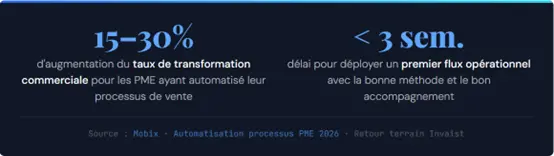
✅ The reality: Method is everything. Identify the right process, map it, connect the existing tools, test on a limited scope, then expand. This gradual approach makes automation simple, controllable and immediately profitable, without disrupting the existing organisation, without lengthy training and without opaque technological dependence.
What these myths have in common
These four beliefs share the same origin: a picture of intelligent automation frozen in the past, fuelled by examples of large industrial projects or complex IT transformations that have nothing to do with the intelligent automation of an SME’s business processes.
The reality in 2026 is clear: intelligent automation is accessible, affordable, quick to deploy and well received by teams. SMEs that cling to these beliefs are not just losing time; they are letting their most responsive competitors build a growing lead.
The only relevant question is no longer “is intelligent automation for me?” but “which process do I start with?”
FAQ
Is intelligent automation really accessible to an SME without an IT team?
Yes. Modern intelligent automation solutions let small businesses deploy effective workflows without any particular IT skills. With a specialist partner, the first workflow is operational in under 3 weeks. Your role: know your own processes.How do you assess the ROI of intelligent automation in an SME?
Define 2 simple indicators before deploying each workflow: average time on the task before/after, and volume processed or error rate. Administrative automation projects (invoicing, reminders, reporting) generally break even within 3 to 6 months. Start by timing your 3 most repetitive tasks; the potential becomes immediately visible.Will my teams accept intelligent automation?
In 81% of cases, yes — that is the figure from the study of 317 French business leaders (Économie Matin, Oct. 2025). Intelligent automation eliminates the tasks employees generally don’t like doing: repetitive data entry, manual consolidations, out-of-context reminders. The key is to involve them from the diagnosis stage and show them what the first workflow concretely frees up in their daily work.Which process should an SME start with for intelligent automation?
Identify the most repetitive and time-consuming task in your typical week. The best first candidates: entering leads in the CRM, generating invoices, customer reminders, weekly reporting. These processes are stable, rule-based and offer a visible ROI in under two weeks.Want to know where to start?
Invaist audits your processes, identifies the quick wins and deploys your first automated workflow. No IT team. No disruption to your organisation. In under 3 weeks. No commitment · Reply within 24h
Book a free diagnosisRead also
Our related solutions