Not every process can be automated and, above all, not every process can be automated right now. The question most often asked by business leaders interested in intelligent automation is not “how do we automate?” but “where do we start?”. And it is the right question. Because most automation projects fail not because of the tool chosen, but because of the process chosen.
Automating a bad process only speeds up its inefficiency. Automating a good process at the wrong time produces disappointing results. Intelligent automation therefore starts with an act of judgement, not with a software purchase.
What is an automatable process?
An automatable process is a sequence of tasks that can be carried out reliably by a software system, without human supervision at every step, because it follows stable rules, uses accessible digital data and does not require complex contextual judgement each time. Intelligent automation adds a layer: it lets the system adapt its behaviour to the data received, within the limits set by humans.
This definition immediately excludes two categories of tasks:
- Those that require a strategic decision every time (complex customer relationships, negotiation, management trade-offs)
- Those whose rules change too often to be formalised. This is not a technological limit; it is a limit in their very nature.
The good news is that in any SME, a very significant share of daily operational tasks meets the criteria for automation. According to McKinsey, 57% of current working hours are technically automatable with the tools available today.
The 3R rule: the basic filter
Before any in-depth analysis, a process must pass the 3R filter to be considered a candidate for intelligent automation (in French: Répétitif, Réglé, données numériques — Repetitive, Rule-based, digital data). If one of the three criteria is missing, the process is not ready yet and must first be restructured.
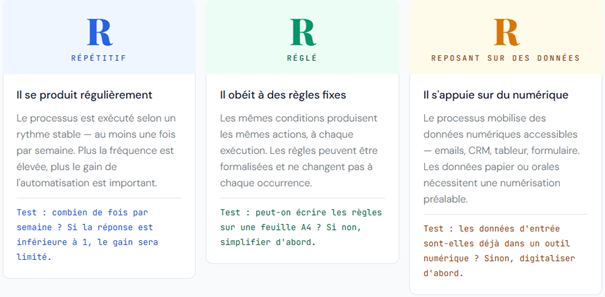
The most common trap: Trying to automate a process that does not yet meet the “Rule-based” criterion. Automating inconsistency only produces inconsistency faster.
The absolute rule: map first, simplify the exceptions, then automate. One hour of simplification upstream saves weeks of corrections after deployment. To go further, read our article onthe 7 critical mistakes to avoid in automation.
The 3 prerequisites to meet
Beyond the 3Rs, three prerequisites determine whether a process is ready to be automated now or whether it first needs groundwork.
Prerequisite 1: Reliable, clean data
This is the “garbage in, garbage out” principle: an automated system is only as reliable as the data it consumes. Before configuring any workflow, check that your source data (CRM, spreadsheet, management software) is complete, consistent and structured. Cleaning the data upstream is often the most decisive phase of the project and must not be neglected.
Prerequisite 2: Rules that fit on one page
If you cannot describe the process in a few clear rules (if X then Y, otherwise Z), it is not yet structured enough to be automated. Formalising the rules is itself a valuable exercise: it often reveals inconsistencies or unnecessary steps that should have been removed long before.
Prerequisite 3: A minimum of stability in the rules over time
A process whose rules change every month is hard to automate sustainably; maintenance will cost more than the gain. This does not mean the process must never evolve, but that it must remain stable long enough to recoup the configuration investment. In practice, 6 months without major change is a reasonable minimum.
The prioritisation matrix: where to start?
Once the 3Rs are validated and the prerequisites are in place, the next question is: in what order? Not all automations have the same return on investment, and it would be counter-productive to start with the most complex ones. The following matrix organises processes along two axes: theirpotential impactand theirease of deployment.
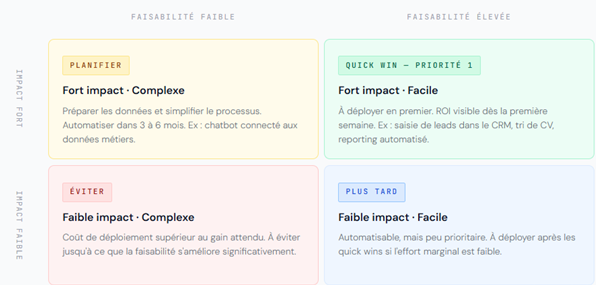
This matrix applies to every process identified in your SME. In practice, thequick wins are almost always the same: invoice entry, CV screening, marketing content, customer support & AI agents, onboarding and lead scoring. These are the processes we describe in detail in our guide tothe 6 processes to automate first in an SME.
Concrete examples: yes, no, maybe
Theory is useful; examples are even more so. Here is how to apply the 3R rule to concrete, everyday SME situations.
Example 1 – Yes, automate now!
Entering incoming leads into the CRM: Every form submitted on the website triggers exactly the same actions: create a contact record, qualify the lead against defined criteria, notify the sales rep. The rule is stable, the frequency high, the data digital. The 3Rs are met. Feasibility is high and the ROI quickly visible.
Example 2 – Maybe, after simplification
Handling incoming customer requests: Part of it can be automated (answers to frequent questions, acknowledgements, routing to the right person). Another part cannot yet (complex complaints, custom requests, negotiations). You first need to map the types of requests, automate the standard cases (often 60 to 70% of the volume) and keep human escalation for complex cases. This is precisely what the HITL principle allows.
Example 3 – No, not automatable yet
Defining the quarterly sales strategy. Even if decision-support tools can enrich this thinking, the process itself does not meet the “Rule-based” criterion: it involves contextual judgement, analysis of uncertainties and strategic trade-offs that cannot be formalised as fixed rules. Intelligent automation is not meant to replace this kind of decision; it frees up time to really focus on it.
The decisive criterion: where does AI stop and where does the human start?
The subtlest and most important criterion is defining the boundary between what AI can do on its own and what requires human approval. This is the HITL (Human-In-The-Loop) principle.
- What AI does in intelligent automation: It carries out predictable tasks: data entry, sorting according to defined criteria, sending communications based on scenarios, generating documents from templates, entering invoices. It acts within clear rules, on standard cases.
- What the human does in intelligent automation: They approve the decisions that really require it: approving a customer reply on a sensitive topic, ruling on an unusual case, making a strategic decision on a high-stakes prospect, adjusting the system’s rules when the context changes. The human stays in control, and HITL is the mechanism that guarantees it.
In practice, defining the HITL boundary for each process is a key step in the design phase. It answers the question:in this workflow, at which step must the human necessarily step in, and why?This thinking is also useful for teams: it makes clear that intelligent automation does not remove their role; it refocuses it on what really adds value.
The 5 steps to qualify a process
Here is the operational method thatInvaist applies in every diagnosis. Any SME can replicate it on its own in less than a day’s work.
- Observe and time
For one week, note all the repetitive tasks that you or your team do “on autopilot”. For each one, note the frequency and the average time. This time is your maximum potential gain. Don’t theorise; observe.
- Apply the 3R filter
For each process identified: is it Repetitive? Is it Rule-based? Does it rely on digital data? If one of the three criteria is missing, file the process under “to prepare” rather than “to automate”. Don’t force it.
- Map each step
On paper, describe each step of the process, its triggers, its actors and its exceptions. This mapping often reveals obvious simplifications that had never been formalised. The rule: simplify first, automate second. Never automate a process that has not first been clarified.
- Define the HITL boundary
For each step of the process, decide: can AI carry it out alone, or is human approval needed? Formalise the exceptions and the escalation criteria. This design work is the most important in the whole project, and it is the one most often rushed.
- Place it in the matrix and prioritise
Place the process in the impact/feasibility matrix. Always start with the quick wins: they produce a visible ROI quickly, build internal buy-in and prove the value of the approach. More complex processes will follow later, on solid foundations.
The 6-question qualification checklist
Before any deployment, answer these 6 questions:
- Is this process carried out at least once a week?
- Can its rules be written on less than one A4 page?
- Is the input data already digital and structured?
- Will the rules remain stable for at least 6 months?
- Is there at least one step where a human clearly has to approve?
- Does the time saved clearly exceed the deployment cost?
If you answer yes to all of them: automate now. If one answer is no: first identify what is missing.
FAQ
What is an automatable process?
An automatable process is a sequence of tasks that meets three fundamental criteria: it is repetitive (carried out regularly), rule-based (follows fixed rules without complex judgement) and relies on accessible digital data. If one of these three criteria is missing, the process first needs to be simplified or restructured before being automated.How do you prioritise the processes to automate in an SME?
The most effective method combines two axes: impact (time saved, errors avoided, revenue secured) and feasibility (available data, stable rules, low technical complexity). High-impact, highly feasible processes are the “quick wins” (lead entry, CV screening) and should be deployed first.Should you simplify a process before automating it?
Yes, it is a non-negotiable prerequisite. Automating an inefficient or poorly structured process only speeds up its flaws. The rule is simple: map first, simplify next, automate last. One hour spent simplifying the process before configuring it saves weeks of corrections after deployment.Which processes should not be automated?
Processes involving complex human judgement, a sensitive emotional relationship, non-standardised strategic decisions or rules that change very often are not good candidates. The HITL principle defines this boundary precisely: AI carries out predictable tasks, the human approves and decides on the cases that really require it. This is not a technological limit; it is a limit in their very nature.How long does it take to qualify a process and deploy it?
The qualification phase generally takes 2 to 4 hours for a simple process. Deployment itself, with a partner like Invaist, takes less than 3 weeks for a first workflow. The qualification phase is often shorter than expected and often more revealing, because it highlights simplifications nobody had formalised.Which process in your SME passes the 3R filter?
Invaist diagnoses your processes, applies the prioritisation matrix and deploys your first workflow in under 3 weeks.
Free 30-minute audit · No commitment · Reply within 24h
Read also
Our related solutions