Automation is no longer optional. In 2026, it is a matter of survival.
The digital giants no longer have a monopoly on it: AI and low-code tools have democratised automation. For small and medium-sized enterprises (SMEs), not acting means accepting being overtaken — not by competitors, but by their own inaction.
Why 2026 is the decisive year
En 2024, only 10% of French SMEs were using AI.
By the end of 2025, this figure will exceed 20%.
En 2026, integrating artificial intelligence into business processes will no longer be an asset but a minimum requirement.
The 3 indisputable benefits for your SME
1. Free up 40 to 100 hours a month
Automate repetitive tasks : invoicing, reminders, data entry, reporting.
- A reduction of 20 to 30% in operating costs
- An increase of 14,5% in sales productivity (CFIB)
2. Use the customer experience as a loyalty tool
Smart chatbots handle 80% of routine requests. Marketing automation campaigns aim to reach prospects at the right moment.
According to Forrester, carefully nurtured prospects generate orders that are higher by 47%.
3. Augment rather than replace: free up your teams
Artificial intelligence does not make jobs disappear; it transforms them.
By delegating routine tasks, your employees can focus on:
- Developing strategies
- Innovation
- Empathy towards the customer
According to the ILO, AI is likely to create 10 to 13% more jobs rather than eliminating them.
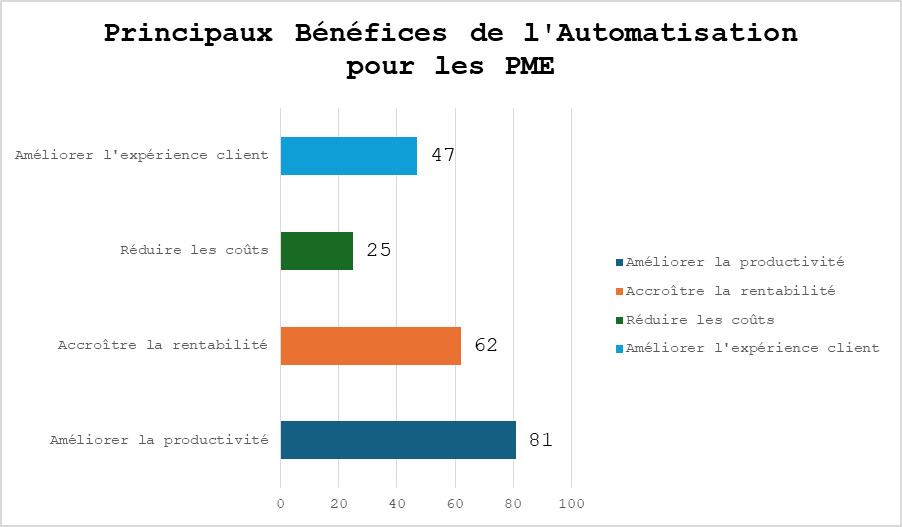
Source: CFIB, Le Devoir, Les Affaires
The accessible toolbox (no code, no crazy budget)
✅ Low-code / no-code: the SME’s secret weapon
Create complex automations with little development. Connect your CRM, your mailbox, your invoicing program and many other applications.
→ Result: deployment in days, not months. Costs reduced by 70%.
✅ Customised AI: your business assistant, not a generic ChatGPT
In 2026, competitive SMEs will have an AI assistant trained on their own data:
- Internal methodologies
- Customer history
- Answers to sales objections
→ It becomes an extension of your expertise, available 24/7, accurate and scalable.
Your action plan: the steps to avoid burning out
Before you start, ask yourself some questions about business process automation. This gradual logic lets you approach automation as a controlled operational lever rather than a heavy, energy-draining undertaking. Then follow these steps:- Identify the most painful process (for example: customer reminders, quote management).
- Automate it in 14 days.
- Measure the gains, then reinvest them in the next process.
- Automation is not a project. It is a culture.
- It is not necessarily the SME that uses the most tools that wins.
- It is the one that learns fastest.
Conclusion: it’s not for tomorrow. It’s today.
In a year’s time, the small and medium-sized businesses that delayed will probably be asking themselves: “How did we do it before?”
You will have freed up time, increased your margins and built customer loyalty while keeping your teams motivated.
The revolution does not take a break. Start with a single process. And take action.
👉 Find out how Invaist guides you towards intelligent automation, step by step, by emailing us at [email protected] or by sending a message on our LinkedIn page !
Ready to automate without complexity?FAQ
What is customised AI for an SME, and how is it different from ChatGPT?
A generic AI assistant such as ChatGPT answers based on general public data. Customised AI for an SME is trained on the company’s own data: internal methodologies, customer history, answers to sales objections, specific processes. It becomes an extension of the company’s business expertise, available 24/7, accurate on the company’s topics and scalable with no marginal cost. It is the difference between an intern who reads books and an expert trained in the field for 5 years.How can you automate a first process without disrupting the organisation?
The 4-step method: 1. Identify the most painful process (reminders, quotes, data entry). 2. Map each step on paper; 2 hours are enough. 3. Configure the workflow on a no-code platform by connecting the existing tools. 4. Test on a limited scope for 1 week, measure the time saved, adjust if needed. By week 3, the workflow is operational. The organisation is not disrupted because no existing tool is changed; they simply communicate better.Are no-code tools suitable for an SME without an IT department?
Yes, that is precisely what they were designed for. The rise of no-code platforms combined with AI is a major technology trend for 2026, making it possible to create automations without hiring developers. For an SME, this means: deployment in days, costs reduced by 70% compared with traditional IT projects, and maintenance with no dependence on in-house IT.How can you concretely measure the gains from automation in an SME?
Define 2 or 3 simple indicators before deployment: average time on the task before/after, error rate, volume processed, customer response time. Measure them at D+7, D+30 and D+90. The most common gains: a 20 to 30% reduction in operating costs, a 14.5% increase in sales productivity, and 40 to 100 hours a month freed up on administrative tasks. These measurements justify deploying the next workflows and build the internal buy-in needed to go further.Which SME sectors are the most advanced in automation in France in 2026?
The most advanced sectors are those where data volumes and repetitive processes are greatest: B2B services (quote management, reminders, reporting), real estate (tenant files, mandates), distribution and logistics (stock management, orders), and accounting/finance (invoice processing, reconciliations). Industrial SMEs are also progressing fast thanks to intelligent document processing tools.Read also
Our related solutions