In 2026, intelligent automation is no longer just a technology trend but a strategic imperative for SMEs. Yet many French SME leaders still show marked reluctance towards it. This paradox raises a fundamental question: why do so many leaders still resist? And above all: are they wrong?
Every week, in management meetings, chamber of commerce training sessions or Bpifrance breakfasts, the same conversation comes up. A business owner says:“Automation is fine for big companies. We’re too small, too specific, too busy.”The people around them nod. And yet, meanwhile, their European competitors are moving at a different speed.
This article is not a list of miracle recipes. It is an honest analysis of the (often legitimate) reasons why SME leaders hesitate
- The paradox of reluctance: why do French SME leaders hesitate?
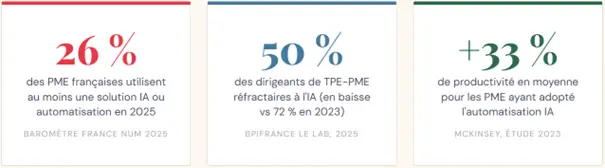
France is not lagging behind in awareness. 85% of French small-business leaders see AI as a survival issue in the medium term. That is an encouraging figure.
But between conviction and action there is a gulf. According to the Bpifrance study of October 2025, 47% of business leaders want to speed up the integration of AI into their company, but only 32% actually use it. The gap between intention and action reveals deep barriers, which must be named in order to overcome them.
For an SME leader already overloaded with daily decisions, intelligent automation is one more decision, with high perceived uncertainty and benefits that seem distant. Except that the benefits are very tangible.
- The 5 real barriers, and why they don’t hold up
Let’s break down the most common objections SME leaders raise about automation. Not to dismiss them, but to answer them with concrete data.
2.1. Barrier no. 1 — “It’s too expensive for an SME”
Cost is cited by 39% of business leaders as the first barrier to adopting AI (Bpifrance, June 2025). The idea that you need hundreds of thousands of euros to automate is firmly rooted.
✅ The reality: Custom solutions let you start for a few hundred euros a month. Intelligent automation applied to invoicing or customer reminders generates an ROI of 30 to 200% in the first year. Starting small, with a single process, is not only possible but recommended.
2.2. Barrier no. 2 — “We don’t have the skills in-house”
Nearly 75% of French SMEs and mid-caps mention the lack of people able to identify and manage an automation project, according to The Reveal Insight Project. 55% cite lack of time as a barrier to digital training (France Num 2025 barometer (France)).
✅ The reality: You don’t need to hire a data scientist. Studies show that SMEs that succeed rely on external experts for design and commissioning, then train an internal “process owner” (1 to 2 hours a week is enough). Outsourced support is the norm, not the exception.
2.3. Barrier no. 3 — “Our business is too specific to be automated”
Many SME leaders put forward the perceived complexity of the transformation as a major obstacle. The specificity argument comes back like a mantra in industry, crafts and niche services.
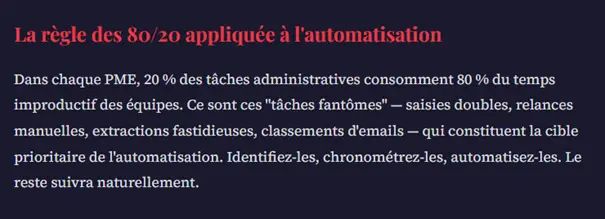
✅ The reality: 80% of accounting tasks (invoice processing, expense reports, archiving, reminders) can be automated whatever the sector. Being a specialist business does not protect you from time-consuming administrative tasks.
2.4. Barrier no. 4 — “My teams will resist or fear losing their jobs”
Resistance to change is a real barrier. The fear of losing one’s job, or simply of changing habits built up over years, creates internal tension that makes leaders hesitate before launching any project.
✅ The reality: SMEs that have adopted AI save on average 1.5 hours per day per employee (Gartner, 2024). That time is reinvested in value-adding tasks and innovation. Intelligent automation frees human capital; it does not replace it. Transparent communication and involving teams from the pilot phase are the keys to buy-in.
2.5. Barrier no. 5 — “I can’t see the return on investment”
Leaders may struggle to identify concrete use cases for their business. Without a visible ROI, the investment decision becomes hard to justify. In an uncertain economic context, with cash flow under pressure for many SMEs, every expense must prove its value quickly.
✅ The reality: SMEs that automate a targeted process see a much faster ROI than expected, because they start from a concrete problem, not an abstract technology. Unpaid-invoice reminders, double data entry, periodic reports: these are “pain points” whose real cost is invisible until the day you measure it. The key: start with a precise “pain point” (unpaid-invoice reminders, double entry, periodic reports) and measure from the pilot phase.
- The processes that are easiest to automate right now
The classic mistake is wanting to automate everything at once. The winning approach is to start with a single repetitive process, measure, then expand.
Here are the areas where French SMEs generate the fastest gains:
- Invoicing and accounting: automatic entry of supplier invoices, bank reconciliations, unpaid-invoice reminders. 80% of these tasks can be automated without much complexity.
- Customer relations: automatic qualification of incoming leads, answers to frequent requests, CRM pipeline tracking. A mid-sized consulting firm improved its customer satisfaction through intelligent automation of these tasks alone.
- Digital marketing: automated content scheduling and publishing, generation and optimisation of marketing content, and automatic creation of performance reports.
- Stock management and logistics: a food-industry SME cut its order processing time by 30% by automating its logistics. A direct impact on working capital.
Conclusion: inaction has a cost that the figures make visible
Rejecting intelligent automation is not a neutral stance. It is a choice that has a price. While an SME hesitates, its competitors save time, reduce their processing errors and free their human capital for value-adding work.
The barriers are real. Lack of skills, tight budgets, perceived complexity, team resistance: these are not baseless excuses. They are problems that can be solved, one by one, provided you start somewhere and don’t aim for perfection on day one.
Ready to take the plunge?
Start by identifying the most time-consuming process in your company this week. A 30-minute express audit can reveal savings of hundreds of hours a year.
30-MIN EXPRESS AUDITRead also
Our related solutions