What if summer were the best time to prepare your future business AI agents?
In many SMEs, July and August mean quieter activity, partly absent teams and a less intense operational pace. Yet this period is often under-used. Rather than seeing it only as a slack period, it can become a strategic window to analyse, structure and improve the organisation.
Mapping your business processes in summer lets you look at your practices with more perspective, identify day-to-day irritants and prepare a smoother, more efficient and better-managed return in September.
Mapping to know what an AI agent can really execute
Business process mapping is not just about “tidying up” the organisation. Above all, it lets you distinguish three categories of tasks:
- The repetitive, structured tasks, which can be carried out by an AI agent.
- The sensitive decisions, which must remain under human supervision.
- The hybrid areas, where the agent prepares, analyses or recommends, but the human approves.
It is this distinction that makes all the difference between controlled automation and risky automation.
A supervised AI agent is not meant to blindly replace teams. It can prepare a file, summarise information, check that a request is complete, generate a first reply, update a tool or trigger an action. But when the stakes are commercial, legal, HR, financial or strategic, the human must stay in control. This is the principle of Human-in-the-Loop (HITL) : the AI acts within a defined framework, with clear approval points. In other words: the agent executes, the human decides.
Yet many SMEs reject automationfor lack of time. During busy periods, teams are absorbed by urgent matters, day-to-day trade-offs and sales priorities. As a result, processes remain implicit, sometimes poorly documented, and dysfunctions become entrenched.
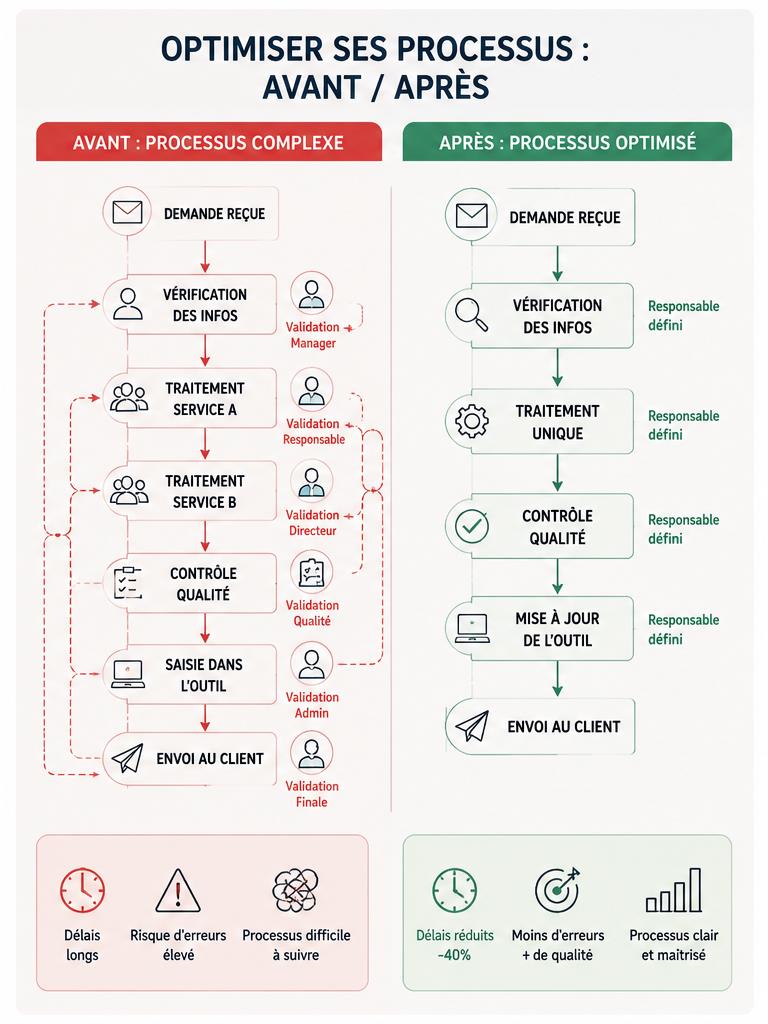
Why July and August are an opportunity to identify the right AI use cases
Summer creates conditions that are very favourable to analysing business processes. Activity is often less dense. There are fewer meetings, projects move at a more moderate pace and some decisions are postponed until September. This relative drop in pressure lets you step out of execution mode and into observation mode.
In July and August, organisations often run with reduced staff. This can reveal weaknesses that are not always visible the rest of the year: no backup, lack of documentation, difficulty finding information, a process too dependent on one key employee, or a tool used differently by different teams. These signals are valuable for identifying use cases for supervised AI agents.
Not all tasks should be automated in the same way. Some can be carried out directly by an AI agent. Others should be prepared by the agent and then approved by a human. Others still should remain entirely human. Mapping is precisely what lets you set these boundaries.
Observing processes “cold” before the busy season
One of the great advantages of the summer period is the chance to observe processes “cold”.
During the year, teams are often immersed in action. They know that some steps are cumbersome, that some exchanges are pointless or that some approvals slow projects down, but they lack the time to formalise these observations.
Summer offers time to step back. Topics can be approached with more distance, less urgency and greater clarity. This perspective is valuable for telling real problems apart from occasional irritants.
Mapping your business processes during this period therefore lets you:
- Document existing practices;
- Identify gaps between the theoretical process and the reality on the ground;
- Spot low-value tasks;
- Clarify responsibilities;
- Simplify approval circuits;
- Prepare concrete improvements before the restart.
This approach avoids waiting until September, often a busy period, to discover that the same delays and the same bottlenecks are back.
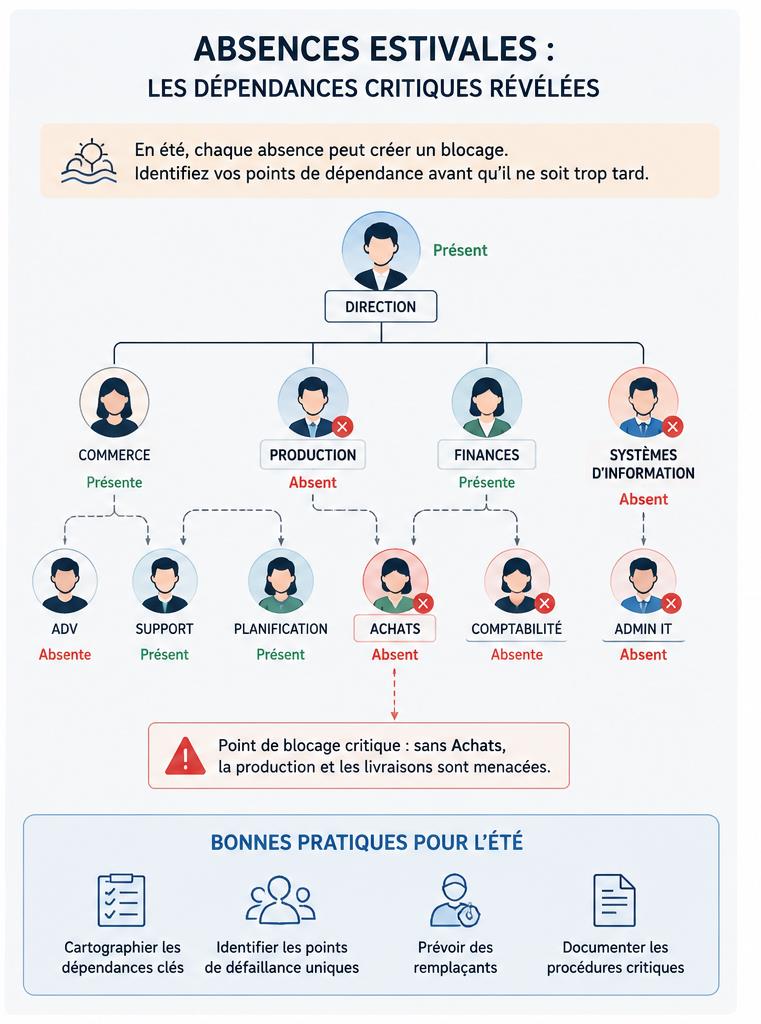
Summer absences reveal critical dependencies
When certain people are absent, processes are put to the test.
Does a customer request stay blocked because only one employee knows how to handle it? Is an approval impossible without one specific person? Is essential information stored in an individual mailbox? Is a shared file incomprehensible to someone not used to it?
These situations are common. They show that the process does not always rest on a clear organisation, but sometimes on habits, tacit knowledge or key people.
Business process mapping then lets you turn these invisible dependencies into usable information. It helps formalise the steps, identify risk areas and put backups in place.
From a business continuity perspective, this is a major issue. A high-performing SME must not only work when everyone is present. It must also be able to keep handling its requests even when the team is not available, during holidays, staff turnover or rapid growth.
Preparing a more efficient, better-structured return in September
The return in September often means an intense restart: sales push, new projects, steering committees, budgets, year-end targets, strategic priorities.
Arriving in September with processes already analysed and documented is a significant advantage. It lets you start the period with a clearer view of the organisation and of the improvement actions to take.
A map produced in summer can serve as a basis to:
- Launch a continuous improvement initiative;
- Prepare an automation;
- Review roles and responsibilities;
- Harmonise practices between teams;
- Onboard new employees more easily;
- Frame an ERP, CRM, workflow or digital transformation project;
- Reduce operational friction before peaks in activity.
The goal is not necessarily to transform everything over the summer. It is rather to use a quieter period to diagnose, prioritise and prepare the decisions for September.
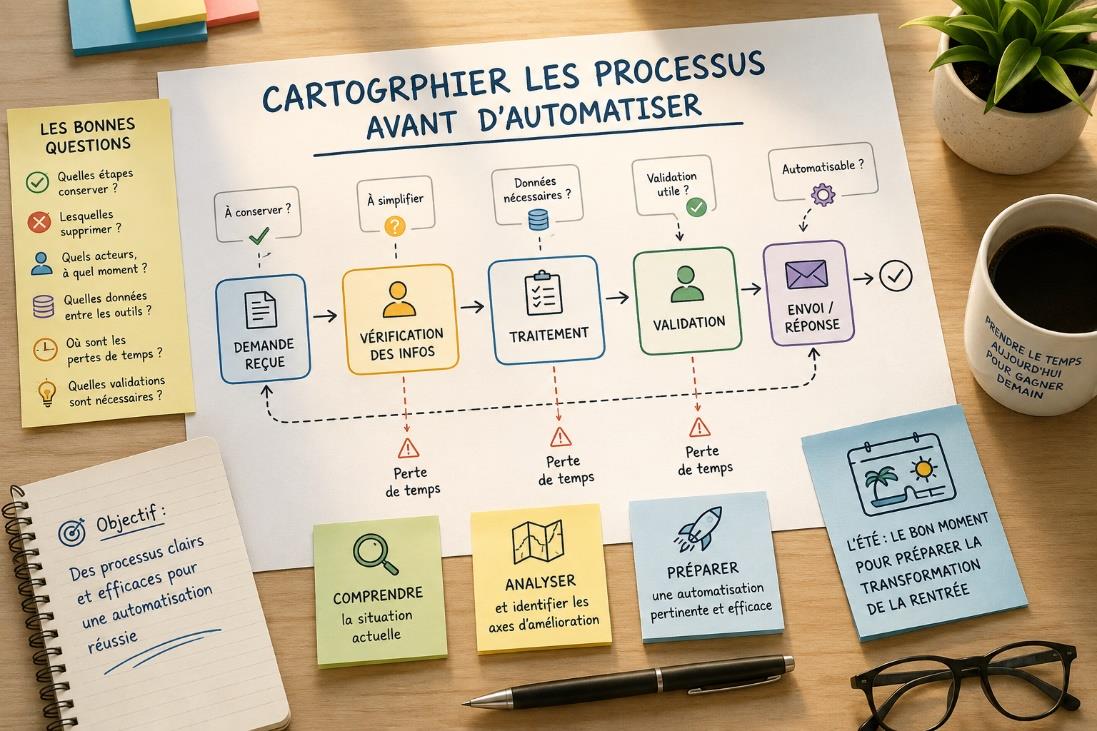
Map your processes before automating
Many companies want to move fast on AI. They identify an irritant, choose a tool, test an agent, then hope to get a quick productivity gain.
As explained in the main process automation mistakes in SMEs, an AI agent, however capable, does not fix a poorly designed process. If it is connected to a muddled flow, it is mostly likely to execute existing errors faster: bad data, vague approvals, poorly defined responsibilities, undocumented exceptions or invisible dependencies.
Before deploying a new tool, workflow or automation solution, it is therefore essential to understand exactly how the existing process works. Automating a poorly controlled process only speeds up its dysfunctions.
That is why mapping must come before automation. Before entrusting a task to a business AI agent, you need to know:
- Which data it receives;
- Which action it can execute;
- Which rule it must follow;
- When it must ask for approval;
- Who supervises its output;
- Which cases must be escalated to a human;
- Which records must be kept.
This step is essential to move from an “autonomous” AI that is hard to control to controlled AI agents built into a clear workflow. The point is not to automate everything. The point is to know precisely what the agent can execute and what the human must decide.
Summer is therefore an ideal time to prepare the digital transformation projects for the autumn. By taking the time to map business processes upstream, the company reduces the risk of deploying unsuitable or overly complex solutions.
A collaborative approach, even with teams partly absent
You might think process mapping requires all teams to be present. In reality, summer can be used intelligently to move forward in stages.
You can start by collecting the available information, analysing existing documents, interviewing the employees who are present and identifying areas of uncertainty. Final approvals can then be done in September with the people concerned.
This gradual approach saves time. Instead of starting from scratch in September, the company already has a first version of its processes, structured discussion points and a list of potential improvements.
The summer period then becomes a time of strategic preparation rather than simply a time of waiting.
Which processes should you map first over the summer?
Not every company needs to map all its processes at once. It is often more effective to start with the most sensitive processes or the most visible ones. Good candidates include:
- Handling customer requests;
- The sales process, from first contact to signature;
- Customer onboarding;
- Complaint management;
- Order processing;
- Recurring administrative processes;
- Invoicing;
- Internal approvals;
- Absence management;
- HR processes for onboarding employees;
- Support or after-sales processes.
The right selection criterion is simple: start with the processes that generate the most friction, dependencies, delays or dissatisfaction, internally as well as externally.
How to succeed with business process mapping over the summer
To make the most of the summer period, it is best to adopt a simple, pragmatic method.
Start by choosing a limited scope. One well-mapped process is worth more than a map that is too broad and hard to use.
Next, observe how things really work. Do not limit yourself to the official procedure. Interview the teams, analyse the tools used, identify informal exchanges and note frequent exceptions.
Then represent the process clearly : steps, actors, decisions, documents, tools and bottlenecks. The goal is not to produce a complex diagram, but a document everyone can understand.
Finally, identify areas for improvement. Some will be quick to implement: clarifying a role, removing an unnecessary approval, centralising a document, standardising a template. Others will require a more structured project to launch in September.
📋 Free checklist
Leave with our ready-to-use business process mapping checklist.
⇩ Download the checklist (PDF, in French)Conclusion: turning the summer lull into an operational advantage
July and August are not just slower months. For companies that want to improve their organisation, they are also months of observation, perspective and preparation.
Mapping your business processes over the summer helps you better understand how the company really works, identify the weaknesses revealed by absences, clarify responsibilities and prepare a more efficient return in September.
In a B2B environment where operational performance, service quality and digital transformation have become major issues, taking the time to analyse your processes “cold” is a strategic decision.
Summer rarely provides all the answers. But it creates the right conditions to ask the right questions before the pace picks up again in September.
FAQ
Why map your business processes in summer?
Summer is a quieter period that lets you step back and look at the organisation. Absences also reveal critical dependencies, gaps in documentation and friction points in internal processes.
Why map your processes before deploying AI agents?
Because an AI agent can only be effective if its scope of action is clear. Mapping lets you identify automatable tasks, the data needed, human approval points and the cases that must be escalated.
What are the benefits of business process mapping?
Business process mapping helps clarify responsibilities, identify unnecessary tasks, reduce lead times, facilitate automation and improve operational efficiency.
Do you need to wait until all teams are present?
No. You can start mapping with the teams available, existing documents and observations on the ground. Additional approvals can be done in September.
Does process mapping help digital transformation?
Yes. Before automating or digitising a process, it is essential to understand how it really works. Mapping helps you avoid automating existing dysfunctions.
Which processes should be mapped first?
It is recommended to start with the processes that generate the most delays, dependencies, errors or dissatisfaction: customer relations, invoicing, request handling, internal approvals, onboarding or support.