Every day, companies receive a mountain of documents: invoices, contracts, payslips, purchase orders, supporting documents… Processing them manually is slow, costly and error-prone. Hence the value of moving to solutions that can not only read these documents but, above all, understand them and use them automatically.
That is where the difference lies between classic OCR and an IDP (Intelligent Document Processing) solution.
OCR: reading, yes… but not understanding
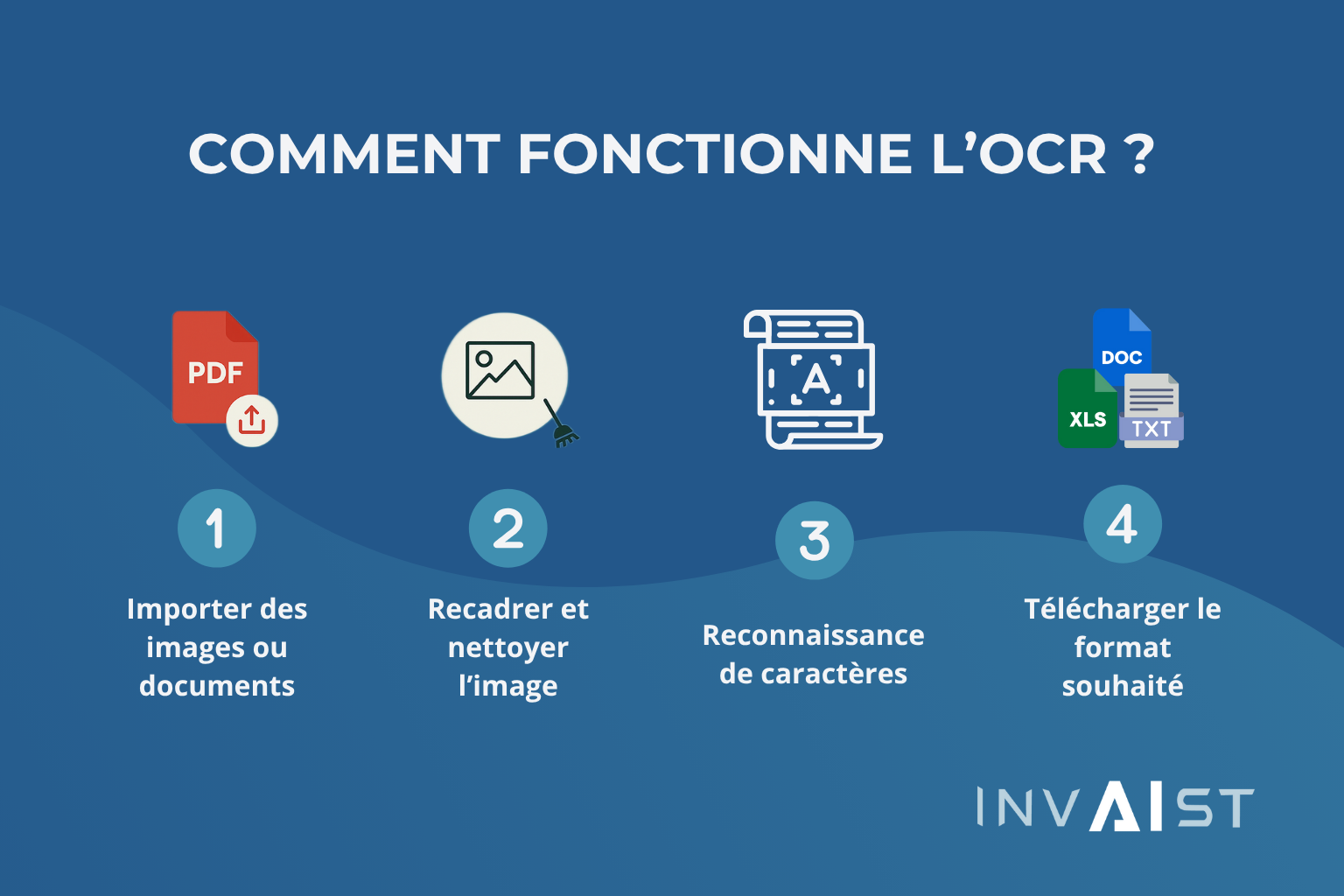
OCR (Optical Character Recognition) is a well-known technology: it converts the text in an image or a PDF into digital text. It is useful forfinding a keyword,copying text, orarchiving scanned documents.
But OCR has no understanding of the content. It cannot tell the difference between a gross amount and an invoice number, or between a date of birth and an issue date. In other words, it reads the document but does not understand what it reads.
As a result, companies still have to step in to sort, validate and organise the information. Automation therefore remainspartial.
IDP: when AI gives meaning to data
L’IDP (Intelligent Document Processing) goes much further. It combines the power of OCR with building blocks ofartificial intelligence, machine learning, and natural language processing (NLP). Its role is no longer just to read the text but to understand its structure, context and intent.
Let’s take a concrete example:
A scanned invoice is not just “read”. IDP automatically identifies that it is a supplier invoice, extracts the key fields (amount, VAT, supplier, issue date), checks the totals and files the document in the right accounting folder.
And it does so even if the invoice comes from another country, in another format, or is slightly blurred.
It is this capacity forself-learning andadapting to new formats that makes the difference.
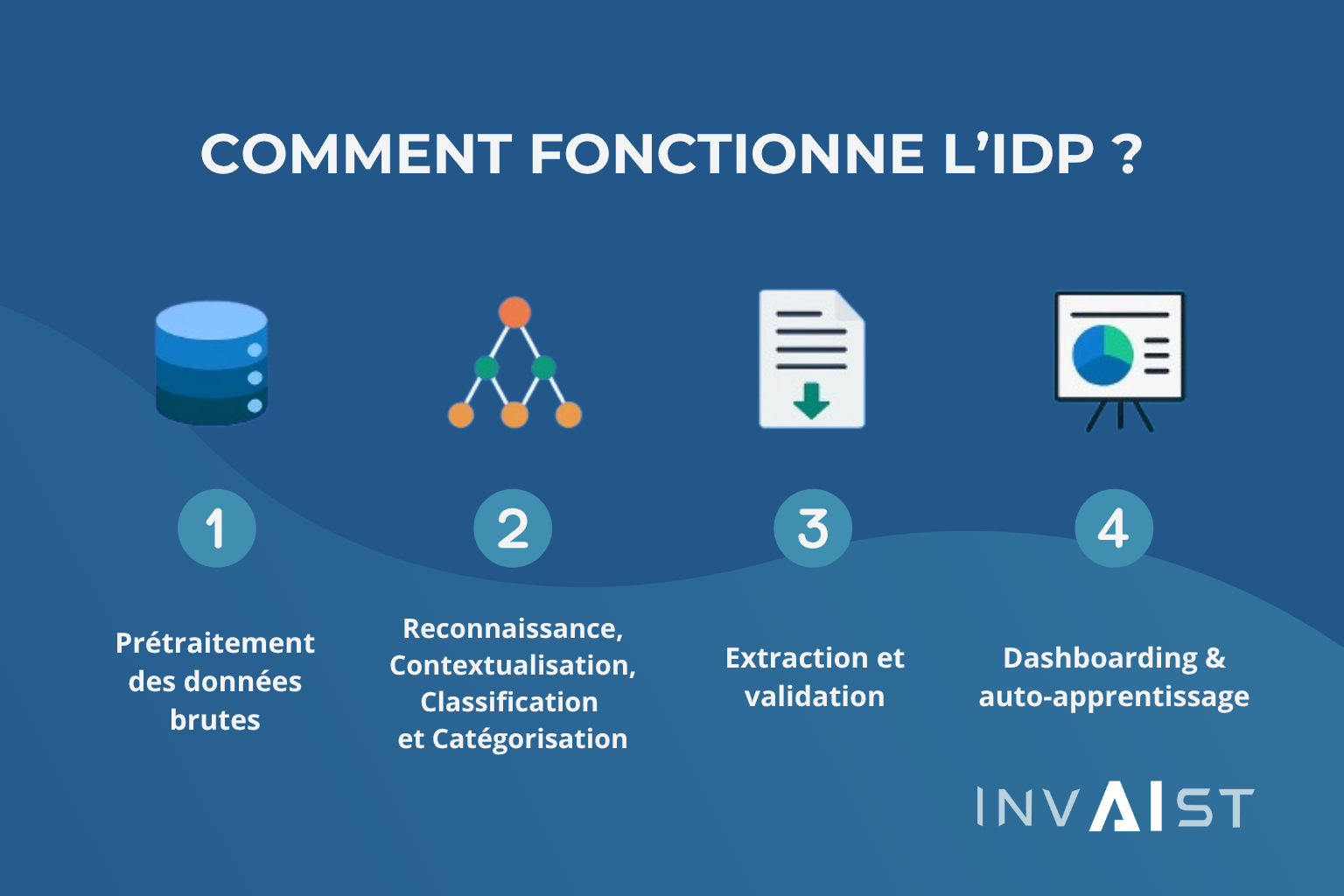
The real change: from reading to understanding
Where OCR stopped at reading, IDPautomates understanding and decision-making. It is a profound transformation of business processes: people no longer enter the data; they validate it.
Thanks to IDP, companies gain:
- time, with large-scale automated processing;
- reliability, thanks to automatic checking of fields and inconsistencies;
- traceability, with every document identified, time-stamped and fed into the right workflow.
The impact is concrete: fewer errors, more productivity, and teams freed from time-consuming tasks.
In short
OCRreads the words; IDPunderstands the meaning. That is the whole difference between simple digitisation andintelligent document automation.
And this difference changes everything: it lets companies focus on what matters —analysis, decision-making and value creation.
Book a meetingFAQ
What is the difference between classic OCR and IDP?
OCR reads the text of a document. IDP understands its meaning. OCR converts pixels into characters; it cannot tell a gross amount from a phone number. An IDP solution combines OCR with artificial intelligence, machine learning and natural language processing to identify the type of document, extract the relevant fields, check their consistency and trigger the right actions downstream. On a supplier invoice, IDP automatically identifies the amount, VAT, supplier and issue date and files the document in the right accounting folder, with no human intervention.Can IDP process invoices in different formats or from abroad?
Yes, this is precisely one of the key advantages of IDP over classic OCR. Its self-learning capability lets it adapt to new formats without manual reprogramming. Whether an invoice comes from a French, European or Asian supplier, whether it is a PDF, a scanned image or a slightly blurred document, IDP extracts the relevant information with a high level of accuracy. This adaptability is impossible with OCR based on fixed rules.What types of documents can an IDP solution process?
IDP is suited to all the structured or semi-structured documents that circulate in an SME: supplier and customer invoices, purchase orders, contracts, payslips, supporting documents, job applications, quotes, delivery notes. For each type of document, IDP learns to identify the key fields and trigger the corresponding actions in your tools (accounting, CRM, HR). The result: people no longer enter the data, they validate it, which fundamentally changes their role and reduces data entry errors.How long does it take for an IDP solution to be operational in an SME?
Modern IDP solutions are designed to be deployed gradually. A first use case (processing supplier invoices, for example) can be operational in 3 weeks. The system then learns and improves continuously on your own documents. There is no need to configure everything at once: start with the type of document with the highest volume or the most time-consuming one, validate the gains, then extend to other categories.Does IDP completely replace human intervention in document processing?
No, and that is an advantage, not a limitation. IDP applies the HITL (Human-In-The-Loop) principle: AI automatically processes standard cases (80 to 90% of documents) and submits ambiguous or high-stakes cases for human validation. People no longer enter data; they decide. This change of role frees up considerable time on repetitive tasks while keeping human control where it is really needed.Our related solutions