How to bring digital tools into your SME without weighing down your organisation, and why intelligent automation is the lever that really makes the difference.
- Intelligent automation and digital transformation: two concepts, one strategy
Digital transformation and intelligent automation are often confused. That mistake leads to poorly scoped projects and disappointing results. Here is the distinction that changes everything.
- Digital transformation
It is the big picture: modernising your company’s organisation, culture and processes through digital technology. A long-term approach that affects both your internal operations and your customer relationships.
- Intelligent process automation
It is the operational lever that executes this vision: identifying repetitive, low-value tasks and entrusting them to software workflows. Faster, error-free, with no marginal cost.
Criterion | Digital transformation | Intelligent automation |
Time horizon | Long term (1–3 years) | Short term (2–6 weeks) |
Scope | The whole organisation | One process at a time |
Visible ROI | 12–24 months | From 3 weeks on the first workflow |
Resources | Dedicated budget, change management | No IT team or exorbitant budget needed |
Digital transformation defines where you want to go. Intelligent automation is the fuel that gets you there, process by process, week by week.
2. Where do French SMEs stand in 2025?
The France Num 2025 barometer (France) (DGE/CRÉDOC, 11,021 companies) paints a mixed picture: the conviction is there, but execution remains incomplete.
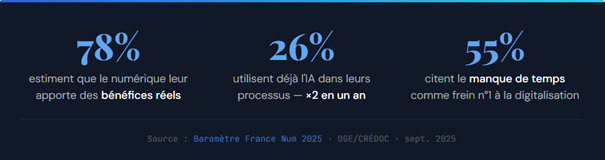
The paradox is telling: amongthe barriers to intelligent automationis the lack of time, precisely what intelligent automation is designed to recover.
3. Which processes should your SME automate first?
The best candidates for automation share three characteristics:
- Repetitive(at least weekly),
- Rule-based(the same rules every time),
- Low in human added value(no judgement, no sensitive relationship).
Within an SME, six categories hold most of the potential:
- Sales management & CRM: Automatic creation of prospect records, assignment to sales reps, quote tracking. Zero leads lost in a shared mailbox.
- Invoicing & collections: Automatic generation on signature, payment tracking, graduated reminders. The system checks before sending; no reminder goes to a customer who has already paid.
- Reporting & dashboards: Automated reporting means automatically consolidating data from your tools, with a report sent every Monday at 8 am. It eliminates 2 to 3 hours of Excel consolidation a week.
- Customer & employee onboarding: Automatic trigger on signature: tool access, welcome emails, scheduling of the first meetings. Complete onboarding, with nothing forgotten.
- Internal communication: Contextual alerts to the right person at the right time. It eliminates pointless follow-up meetings.
- Data centralisation: Automatic synchronisation of all your tools into a single source. No more customer data scattered across five different places.
💡 The golden rule: According toMcKinsey, the ROI of back-office automation (invoicing, reminders, reporting) is3.8 times higherthan that of marketing automation. Always start with operations.
4. Automate a first workflow in under 3 weeks, in 5 steps
Most failures do not come from the technology but from a flaw in method. Here is how to deploy automation in SMEs without disrupting existing teams.
- Step 1: Identify the right process.Which task wastes the most time every week? Start by timing it for 2 days. The answer is always in the data.
- Step 2: Map before automating.Formalise each step: trigger, rules, incoming data, expected output. 2 hours that avoid 2 months of corrections.
- Step 3: Connect your existing tools.The idea is not to replace your CRM or accounting software but to get them talking to each other. Your current tools become more powerful without being changed.
- Step 4: Test on a limited scope.2 weeks, a few real cases, measurement of the time saved. The ROI is visible from D+7 on invoicing and CRM.
- Step 5: Expand methodically.An operational workflow builds internal buy-in for moving on to the next one. The method is the same. Speed increases with each iteration.
5.1. Mistake #1: Buying tools before mapping your processes
A tool amplifies existing processes (good or bad). A poorly designed process, once automated, produces errors at high speed. Map first, then equip.
5.2. Mistake #2: Trying to transform everything at once
SMEs that succeed in their digital transformation do it incrementally: one workflow, a proven ROI, then the next. The big bang is the best way to lose your teams along the way.
5.3. Mistake #3: Not measuring ROI
Without measurement, there is no learning and no justification for going further. Define 2 simple indicators before deploying each workflow: time before/after, volume processed, error rate.
FAQ
What is the difference between digital transformation and intelligent process automation?
Digital transformation is the overall vision of modernising the company through digital technology. Intelligent automation is the operational lever that carries it out: it automates repetitive processes (invoicing, reminders, reporting) without code or an IT team. One sets the strategy; the other puts it into practice.Do you need a technical team to automate processes in an SME?
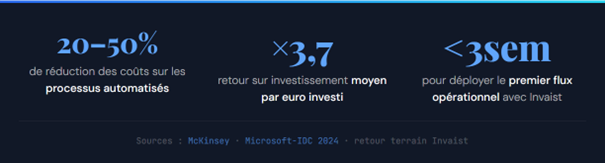
No. With Invaist’s support, SMEs deploy their first automated workflow in under 3 weeks, without involving an in-house technical team. Our role is to manage the complexity; your role is to know your own processes.What ROI can an SME expect from automation?
According to McKinsey, process automation reduces operating costs by 20 to 50% on the targeted tasks. The 2024 Microsoft-IDC study reports an average return of 3.7 times the initial investment. In our field experience, administrative automation projects break even within 3 to 6 months.Will AI automation eliminate jobs?
No. Automation eliminates repetitive tasks, not jobs. It frees your employees to focus on high-value activities: customer relationships, business development, process improvement. It is a lever for performance and for your attractiveness as an employer.Ready to deploy your first workflow? In under 3 weeks.
Invaist audits your processes, identifies your quick wins and deploys your first automated workflow. No IT team. No disruption to your organisation.
No commitment · Reply within 24h
Book a free diagnosisOur related solutions