They are talked about at conferences, in newsletters, around the coffee machine. AI agents. But for an SME with 20, 50 or 200 people, what do they really change?
The honest answer: not much if you only talk about them. A lot, if you identify the right place to start.
In 2024, 10% of French companies with 10 or more employees were already using at least one AI technology, compared with 6% the previous year. Among French small businesses, 26% already had an AI solution. So the question is no longer “does this concern us?”. It is: where do we start without getting it wrong?
That is what this guide is for. Not to impress. To give clear reference points to those who want to move forward intelligently, without jargon or overselling.
What is an AI agent?
An AI agent is a program that can observe a situation, analyse it, make a decision and take action on its own, step by step, to achieve a specific goal.
What sets it apart from a simple chatbot ? It does not just answer a question. It carries out a task from start to finish.
A picture to help understand
A chatbot is an information desk: it answers what you ask it. An AI agent is an autonomous colleague: you tell it what you want to achieve, and it works out the steps to get there.
For an SME, this difference is essential. It lets you move from an assistant that answers questions to a tool that actually carries out tasks — qualifying a prospect, handling a customer request, filing documents, chasing a late order.
How does it work in practice?
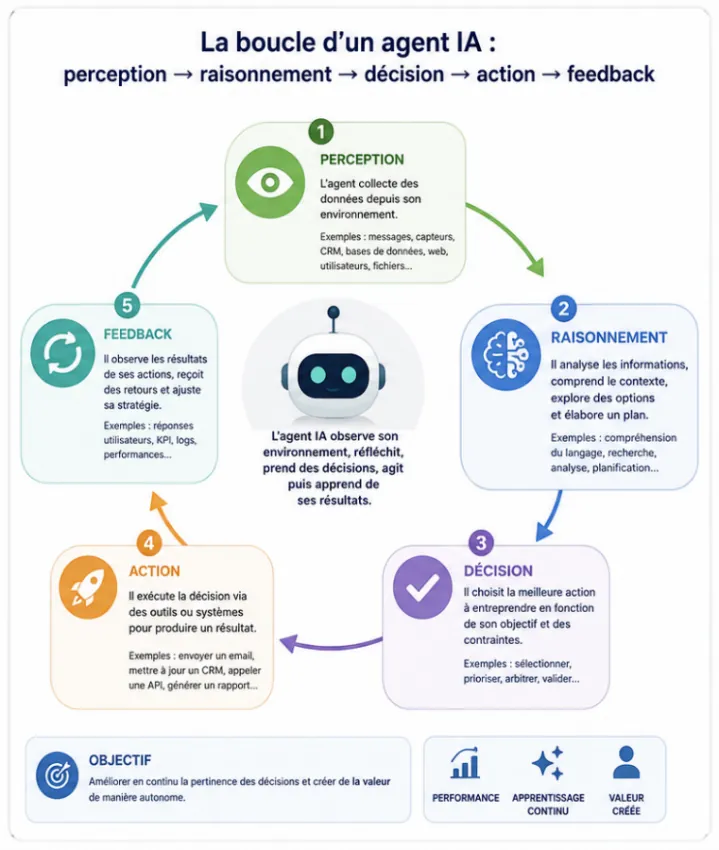
An AI agent follows a simple loop: it observes what is happening, thinks about the next step, acts, checks the result and starts again until the goal is reached.
In practice, this means it can chain several tasks without human intervention at every step. It can read an email, update a file, send a notification, trigger a reminder, all in a coordinated way.
And what about human control?
It is non-negotiable. A well-designed agent prepares, suggests and carries out routine tasks, but the human always approves high-stakes decisions: a sensitive customer message, a large order, an irreversible action. It is this principle, “the agent executes, the human decides”, that makes the tool genuinely reliable and acceptable to teams.
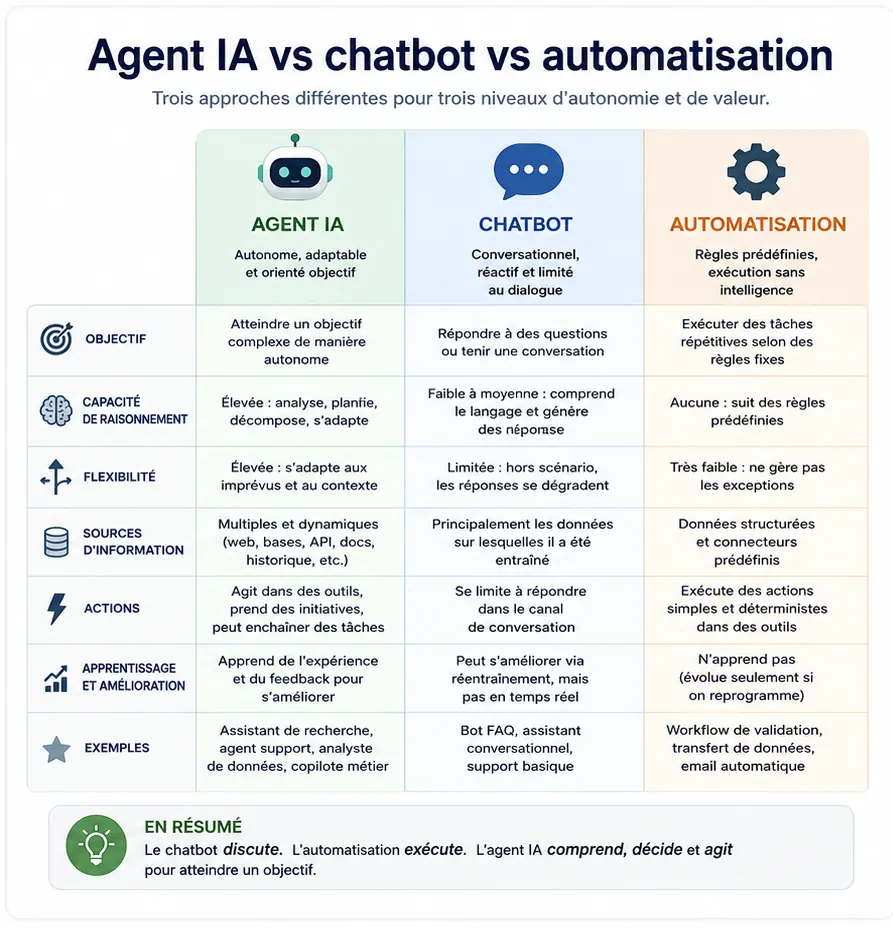
AI agent, chatbot or classic automation?
Here are the three tools at a glance:
| Tool | Main role | Autonomy | Concrete examples |
|---|---|---|---|
| Chatbot | Answering questions | Low | FAQ, appointment booking, first-level support |
| Automation | Executing a fixed rule | Medium | Sending emails, reminders, data transfer |
| AI agent | Reaching a goal in several steps | High | Prospect qualification, full customer support, administrative assistance |
For an SME, these three approaches complement each other very well. Classic automation excels when the scenario is stable and predictable. An AI agent becomes essential as soon as you need to interpret a situation, adapt the response to the context or chain several steps intelligently.
The 8 areas where AI agents have the most impact
The fastest gains come from repetitive, high-volume tasks that everyone on the team finds time-consuming. Here are the eight most promising areas for an SME:
These are not theoretical projects. They are processes that SMEs are putting in place today, with measurable returns within a few weeks.
Why it really changes the way you work
First benefit: productivity. An AI agent handles simple tasks 24/7, without fatigue or careless mistakes. It frees up time for what really needs a human.
Second benefit: consistency. A well-configured agent applies exactly the same rules to every file. No more oversights, no more variations in quality depending on who handles the file that day.
Third benefit: customer experience. Faster answers, better availability, smoother follow-up. For an SME without the resources of a large group, this is often where the return on investment becomes most visible — and fastest.
The mistakes to avoid (and they are classic ones)
Most projects that fail do not fail on technology. They fail before they even start. Here are the four most common pitfalls:
- Automating a process that is already dysfunctional. If your process is unclear or poorly documented, the agent will simply speed up the problem. Automating a bad processmeans producing errors faster.
- Working with incomplete data. Poorly filled-in data, missing information in your CRM, badly named files: the agent then produces mediocre results, whatever its capabilities.
- Launching without clear governance. Who approves what? Who monitors the results? Who corrects things when something goes wrong? Without these clear rules from the outset, the tool becomes hard to trust.
- Choosing the technology before defining the need. The right question is not “which tool should we choose?” but “which problem are we solving?”. Starting from the business need avoids buying a fashionable solution that matches nothing in your reality.
To go further, read our article on the 7 critical mistakes to avoid when automating SME processes.
Deploying a first AI agent in under 30 days
A first agent can be up and running very quickly, provided you keep the scope simple. The golden rule: start small, prove the value, then expand.
| Step | Action | What you actually do |
|---|---|---|
| Week 1 | Process audit | Identify a repetitive, measurable task that wastes time every day. |
| Week 2 | Design | Define exactly what the agent must do, no more, no less. |
| Week 3 | Tests on a small volume | Validate on real cases before expanding. Correct if necessary. |
| Week 4 | Deployment + measurement | Launch, observe, measure the time saved and the quality of the results. |
Which process should you choose first?
Always the same criterion: a repetitive, well-documented task that everyone on the team finds time-consuming. Not the most ambitious project. The one that wastes the most time today.
FAQ
Can an AI agent replace an employee?
No — and that is the wrong way to ask the question. An agent does not replace a colleague. It takes over the repetitive tasks that this colleague should no longer have to do ten times a day. What the agent handles in a few seconds is often what was needlessly consuming human energy.
How is it different from ChatGPT?
ChatGPT is a conversation tool: you ask it a question, it answers. An AI agent goes further: it can chain several actions, access your data (CRM, emails, files) and carry out a complete task without intervention at every step.
How much does it cost?
It depends on the scope and the integration. A simple first agent can start at a few hundred euros a month. A more complete setup generally costs between €1,000 and €5,000 a month depending on complexity. What matters is to think in terms of return on investment: how many hours freed up, how many errors avoided, what improvement in customer service?
Can an AI agent be connected to our CRM or management software?
Yes — and it is even one of the most useful use cases. The agent can read data in your tool, trigger an action and update the system in real time. Most common CRMs and ERPs are compatible.
Are AI agents suited to a company our size?
Yes. SMEs are often better placed than large groups to benefit quickly: processes are less complex to map, teams are more agile, and gains become visible sooner.
Conclusion
An AI agent does not transform a company overnight. And that is not the point.
What changes is a task that no longer ties anyone up. A process that runs without anyone having to think about it. Time recovered from activities that did not need a human to move forward.
The right starting point is always the same: a repetitive, well-documented task that everyone on the team finds time-consuming. Not the most ambitious one. The one that wastes the most time. From there, you build. Step by step. Measuring what it really changes.